Focus music for ADHD: what actually helps
If lo-fi playlists have never quite worked for you, you're not imagining it. Some sound genuinely holds ADHD-type attention and some just fills the room — and the difference is mostly predictable.
Published July 2026 · Written by the Neurowave team · Not medical advice
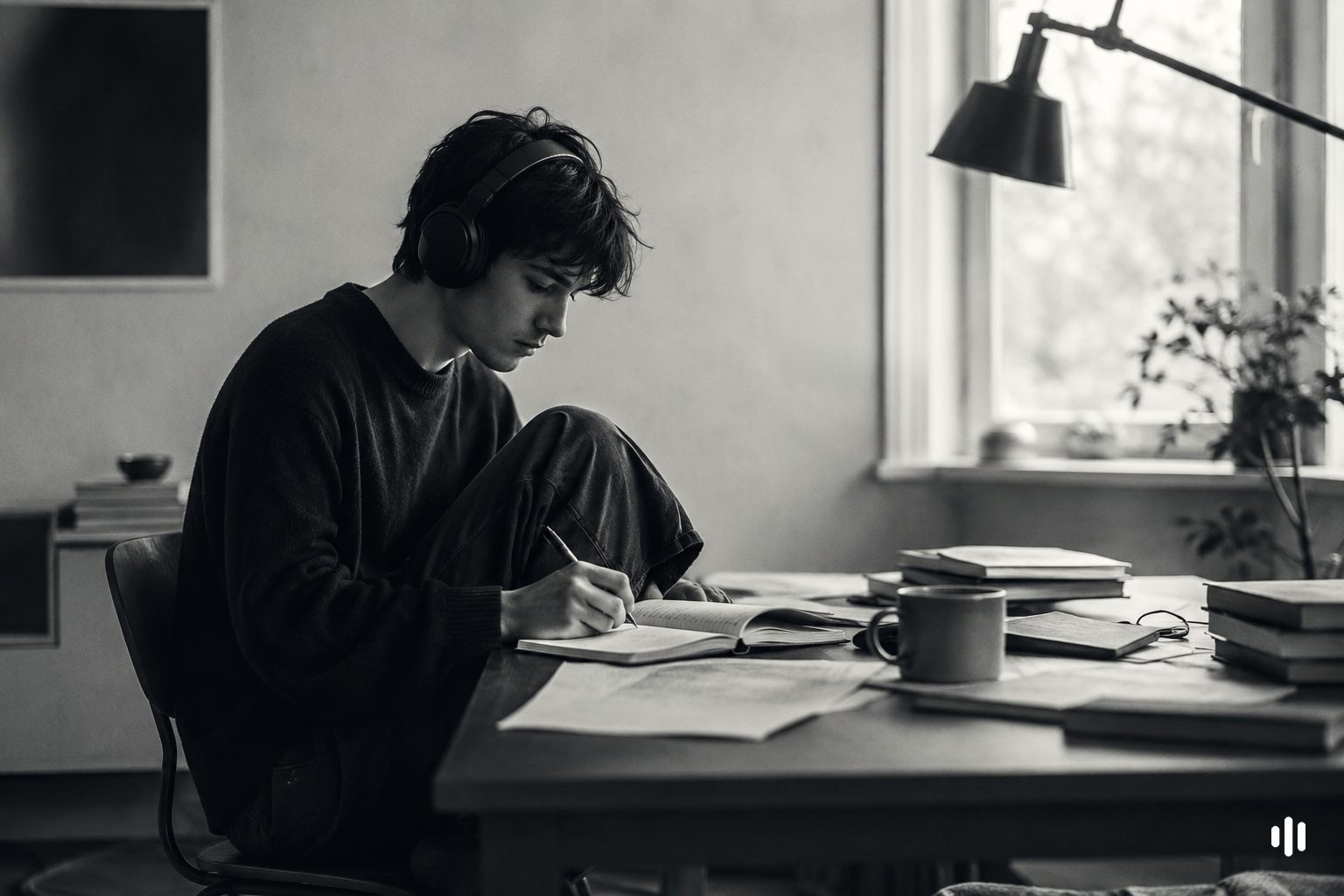
The problem isn't concentration. It's activation.
Ask people with ADHD-type attention what's hard about deep work and very few say "staying focused for hours." They say starting. The gap between deciding to work and actually being in it is where the day disappears — a stretch of tab-switching, snack-getting, and one-more-thing that can eat an hour without producing a sentence.
This matters for choosing audio, because most "focus music" is designed for the wrong half of the problem. Ambient playlists are built to be unobtrusive — to not interrupt a state you're already in. That's useless if you never got in. What helps activation is sound with enough structure to give your attention something to lock onto immediately.
Four properties that separate useful sound from wallpaper
- No lyrics. Language competes directly with the verbal machinery you use to write, read, or code. This is the least controversial finding in the whole area — words in your ears cost you words on the page.
- Low novelty. Every surprise — a key change, a new instrument, a track transition — pulls attention. Music engineered for focus is deliberately repetitive in ways that would be boring as entertainment. Boring is the feature.
- Rhythmic steadiness. A stable pulse gives attention a rail to run along. This is the mechanism entrainment-based audio leans on: a consistent rhythmic structure in the beta range (13–30 Hz) is associated with alert, engaged attention.
- Enough intensity to grip. The most common failure we see: people run focus audio so quietly and so gently that there's nothing to hold. If the sound is barely there, it does barely anything.
Lo-fi hip-hop gets the first two mostly right, which is why it works for some people. It's usually weakest on the fourth: it's designed to be pleasant, not to pull.
Why ADHD listeners often need more, not less
There's a well-discussed idea in ADHD research that some people are chronically under-stimulated relative to what their attention system needs to engage — which is part of why stimulants can be calming rather than activating, and why many people work better in a noisy café than in a silent room. We're describing the pattern, not diagnosing a mechanism; the literature is still arguing about the details.
But the practical implication is consistent with what ADHD listeners report: gentle ambience often does nothing, while something stronger and more structured is what finally holds. That is exactly why Neurowave offers five pulse strengths on CortexDrive™ and lets you turn the intensity up, rather than picking a comfortable middle for everyone. Hyperfocus picks surface only Level 4–5 tracks for this reason.
A setup that works, in five minutes
- Headphones, always — not for loudness, but for isolation and for the stereo separation entrainment audio depends on.
- Pick the track before you start the task. Choosing music is itself a procrastination surface. Decide once, then don't touch it.
- Start at a real intensity (CortexDrive™ Level 3–4). You can always come down; starting too gentle teaches you the tool doesn't work.
- Same sound, same task, repeatedly. The association builds. After a couple of weeks the audio itself becomes a cue that work is starting.
- Don't judge it on day one. Novelty makes anything feel effective for a session. Judge it on week two.
What this is not
No focus-music app treats ADHD, ours included. The clinical evidence bar for treatment is high and no audio product meets it. What sound can honestly offer is an environment that makes starting easier and staying in less effortful — a real, useful, non-medical thing. If you're weighing clinical care, that's a conversation with your doctor, not an app.
For the underlying research on entrainment specifically — what's supported, what's overstated — see our honest read in binaural beats for ADHD focus. If you want to compare the dedicated apps in this space, the comparison hub covers Brain.fm, Endel, and Calm, including where each of them beats us.
Try it on your hardest task
Fourteen days, every mode, every CortexDrive™ level. Start a Deep Work session and see what your first ten minutes feel like.
Download Neurowave on the App Store $39.99/year after trial · Cancel anytimeQuestions, answered plainly
- Does focus music actually help ADHD?
- Many people with ADHD-type attention find that lyric-free, rhythmically steady, low-novelty sound makes it easier to start work and stay in it. The research on auditory stimulation and attention supports small-to-moderate effects on average with large individual variation — and ADHD-specific trials are thin. It is not a treatment, and the only reliable test is a two-week trial on your own real work.
- Why doesn't lo-fi work for me?
- Lo-fi is engineered to be pleasant and unobtrusive, which is the opposite of what an under-engaged attention system needs. It gets the basics right (no lyrics, repetitive) but is usually too gentle to give attention something to lock onto. Stronger, more structured sound often works where lo-fi doesn't.
- Is it better to work in silence with ADHD?
- For some people, yes — but many ADHD listeners find silence is where mind-wandering thrives, which is why cafés and background noise are so commonly preferred. Test both on the same recurring task for a week each rather than trusting general advice.
- How loud should focus music be?
- Loud enough to be clearly present, quiet enough that you're not straining to think over it. The most common mistake is playing it so softly there's nothing for attention to hold. Comfortable and clearly audible is the target — never uncomfortable.
- Do I need headphones for focus music?
- For entrainment-based audio, yes — the effect depends on stereo separation, and headphones also isolate you from the interruptions that break the first ten minutes. Speakers are fine for general ambient sound.
Safety note: if you have a history of seizures, are sensitive to rhythmic light or sound, are pregnant, or have a serious medical condition, talk to your doctor before using entrainment audio. Neurowave is a wellness tool, not a medical device, and nothing here is medical advice or a substitute for clinical care.